

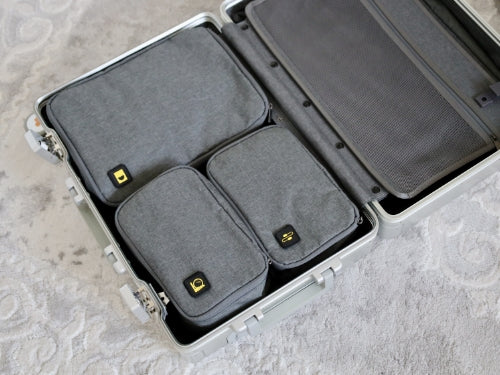




The Difference Between Carry-On Luggage and Check-In Luggage

How you divide your belongings between cabin and checked storage affects cost, convenience, security screening, and what you can reach during the journey. The carry on vs checked bag decision depends on trip length, airline rules, connections, the items you are carrying, and how much airport handling you want to avoid. Many travelers use both: carry on baggage for essentials and baggage check in for bulkier items.
What Is a Carry On Bag?
A carry on bag is the larger piece of cabin baggage that stays with you after check-in. Some travelers use the search phrase baggage carry, but airlines more commonly call it a carry-on, cabin bag, or hand luggage.
You take it through the security checkpoint, lift it into the overhead bin, and retrieve it when you leave the aircraft. Your fare, airline, route, and aircraft can all affect whether a full-size carry-on is included and accepted.
Advantages of a Carry-On Bag
A carry-on keeps medication, documents, electronics, and valuables close at hand. It can also save time because you may bypass the bag-drop desk and baggage claim. If a flight is disrupted or a connection is tight, having your essentials with you makes it easier to adapt.
Disadvantages of a Carry-On Bag
Cabin space is limited, and a bag that exceeds the airline’s size rule may be checked at the gate. You must also carry or roll it through the airport and lift it into the overhead bin. Liquids and certain tools are more restricted in the cabin, so carry-on-only packing requires more planning.
What Is a Check in Baggage?
Checked baggage is handed to the airline before security and transported in the aircraft’s cargo hold. You normally collect it from the baggage carousel after arrival. It offers more packing space, but you lose access to it between bag drop and baggage claim.
Advantages of Checked Baggage
Checked baggage works well for longer trips, winter clothing, large toiletries, family packing, and gear that cannot fit in a cabin bag. It also leaves you less encumbered while walking through the terminal. Within the applicable rules, containers larger than the standard carry-on liquid limit can usually travel in a checked bag.
Disadvantages of Checked Baggage
Checking a bag can add a fee, require an earlier airport arrival, and create a wait at baggage claim. The bag is also outside your control during handling and connections, so delays or damage are possible. Passports, medication, keys, valuable electronics, spare lithium batteries, and irreplaceable items should not be packed in it.

Carry-On Luggage and Check-In Luggage: Key Differences
Carry-on and checked baggage follow different storage, measurement, screening, and handling rules. Always check the operating airline—not only the airline that sold the ticket—before packing.
|
Factor |
Carry-On Bag |
Checked Bag |
|
Storage |
Overhead bin in the cabin |
Aircraft cargo hold |
|
Common U.S. limit |
22 × 14 × 9 in, including wheels and handles |
62 linear in and 50 lb for many standard economy allowances |
|
Access during travel |
Available until stowed and again after landing |
Unavailable from bag drop to baggage claim |
|
Typical strength |
Speed, control, and access to essentials |
More capacity and fewer cabin-liquid limitations |
|
Typical drawback |
Tight size and contents restrictions |
Fees, handling risk, and baggage-claim time |
Size and Measurement
American Airlines, Delta, and United currently publish a maximum carry-on size of 22 × 14 × 9 inches (56 × 36 × 23 cm), including wheels and handles. To measure luggage for carry-on and checked bags, count the fully packed exterior at its tallest, widest, and deepest points; an expanded zipper section or protruding wheel counts.
Checked baggage is often judged by linear size rather than one fixed shape. Add length, width, and height: for example, a 28 × 20 × 12-inch bag equals 60 linear inches. American and Delta currently use 62 linear inches as the standard ceiling for many checked allowances.
Weight and Airline Limits
Many large U.S. airlines publish a size limit without a general cabin-bag weight limit, while numerous international and low-cost airlines do enforce weight. The practical rule is to check the airline restrictions for luggage size and weight for every operating carrier on the itinerary.
For checked baggage, 50 pounds (23 kilograms) is a common economy threshold on major U.S. airlines, and 70 pounds (32 kilograms) may apply to eligible premium-cabin travelers. Limits and fees still vary by fare, route, status, and carrier. The suitcase’s own weight counts toward the allowance.
What You Can Pack
For flights departing from U.S. airports, TSA’s current 3-1-1 rule allows carry-on liquids, aerosols, gels, creams, and pastes in containers of 3.4 ounces (100 milliliters) or less, fitted into one quart-size bag; exemptions apply to items such as medically necessary liquids and infant nourishment.
Battery rules move in the opposite direction. The FAA requires spare lithium batteries and power banks to stay in the cabin, not in checked baggage. Most consumer lithium-ion batteries are limited to 100 Wh; up to two 101–160 Wh spares may be carried only with airline approval, while batteries above 160 Wh are generally prohibited on passenger aircraft.
Fees and Airport Time
A carry-on can reduce baggage-claim time, but some basic or low-cost fares charge for a full-size cabin bag. Checked-bag prices vary by airline, route, purchase date, fare, loyalty status, and whether you pay online or at the airport.
Checked baggage also changes your schedule. You need time for the bag-drop cutoff before departure and for the carousel after arrival. Carry-on-only travel is usually faster, but it may slow you down if the bag is heavy, difficult to lift, or unexpectedly checked at the gate.
How to Choose Between Carry-On and Checked Luggage
Start with the operating airline’s allowance, then consider how long you are traveling and what you need to pack. The best choice is the smallest setup that carries everything safely without exceeding the fare’s limits.
Choose a Carry-On for Short or Business Trips
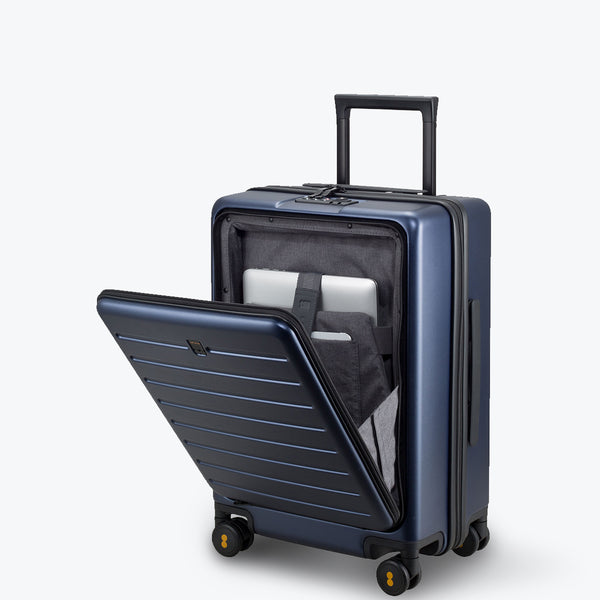
A carry-on is usually the practical choice for a short trip, a tight connection, or an itinerary with frequent train and hotel transfers. Business travelers often need fast access to a computer without opening the main compartment. The LEVEL8 Road Runner Carry-On 20″ addresses that problem with sleeves for a 17-inch laptop and 10.9-inch tablet, a 38-liter capacity, and a 9.5-pound shell.
Choose a Checked Bag for Longer or Equipment-Heavy Trips
Choose a checked bag when extra clothing, cold-weather layers, full-size toiletries, or family items will not fit comfortably in the cabin allowance.
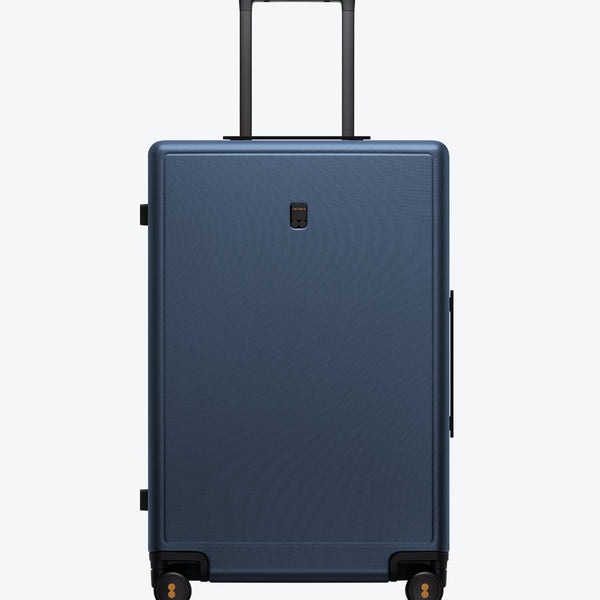
The LEVEL8 Luminous Textured Check-In 24″ provides 65 liters of capacity in a 17.5 × 10.4 × 26-inch body weighing 9.8 pounds; those dimensions total 53.9 linear inches, leaving room below a common 62-inch ceiling while its divider, zipper pockets, and tie-down straps help control a larger load.
Choose a Top-Opening Carry-On for Tight Spaces
A clamshell suitcase needs floor space to open both halves, which can be inconvenient in compact hotel rooms or on a luggage rack. A top opening carry on luggage layout opens from one side, so you can reach the main compartment in a smaller footprint. It is useful when access and space efficiency matter.
Use Both When One Bag Creates a Bad Compromise
Using both can be smarter than overpacking one suitcase. Keep travel documents, medication, valuables, one change of clothes, and permitted battery items in the cabin; place bulky clothing and ordinary full-size toiletries in the checked bag.
This setup gives you backup essentials if the checked bag is delayed without forcing everything into the overhead-bin allowance.
FAQs
Can an Airline Make Me Check a Carry-On at the Gate?
Yes. A compliant bag may still be gate-checked when overhead bins are full, or the aircraft is small. Remove medication, documents, valuables, electronics, and spare batteries first.
Can Smart Luggage Be Checked?
Sometimes. FAA rules generally require a smart bag’s lithium battery to be removable before checking unless it meets the very small installed-battery exception. Confirm the battery specification and airline policy before travel.
Which Baggage Rule Applies on a Codeshare Flight?
Usually the operating carrier’s rule matters at the airport. However, interline and international regulations can affect allowances, so check the booking details and each airline’s policy before packing.
Can I Check a Carry-On-Size Suitcase Voluntarily?
Yes. Airlines usually accept a smaller suitcase as checked baggage if it meets the checked-bag rules and you pay any applicable fee. Remove items that are restricted to the cabin.
Can a Backpack Be a Carry-On Bag?
Yes. A backpack can count as a carry-on if it stays within the airline’s size limit and fits the overhead bin. Smaller backpacks may qualify as personal items instead, depending on the fare and airline.
Conclusion
Carry-on luggage gives you speed, access, and control, while checked baggage gives you more usable packing space. A short or business trip often works well with a cabin bag; a longer, colder, or equipment-heavy trip may justify a checked suitcase. If neither option works alone, split the load deliberately rather than overfilling one bag.
Before every flight, confirm the operating airline’s current dimensions, weight allowance, fees, and restricted-item rules. Measure the fully packed exterior, count the suitcase’s empty weight, and keep essential or cabin-only items with you.


Leave a comment